
We’re Taking the Red Back
How a resistance symbol once banned by fascists is organizing people again


Subscribe free or paid. The Drumbeat runs on defiance, solidarity, and people who show up.
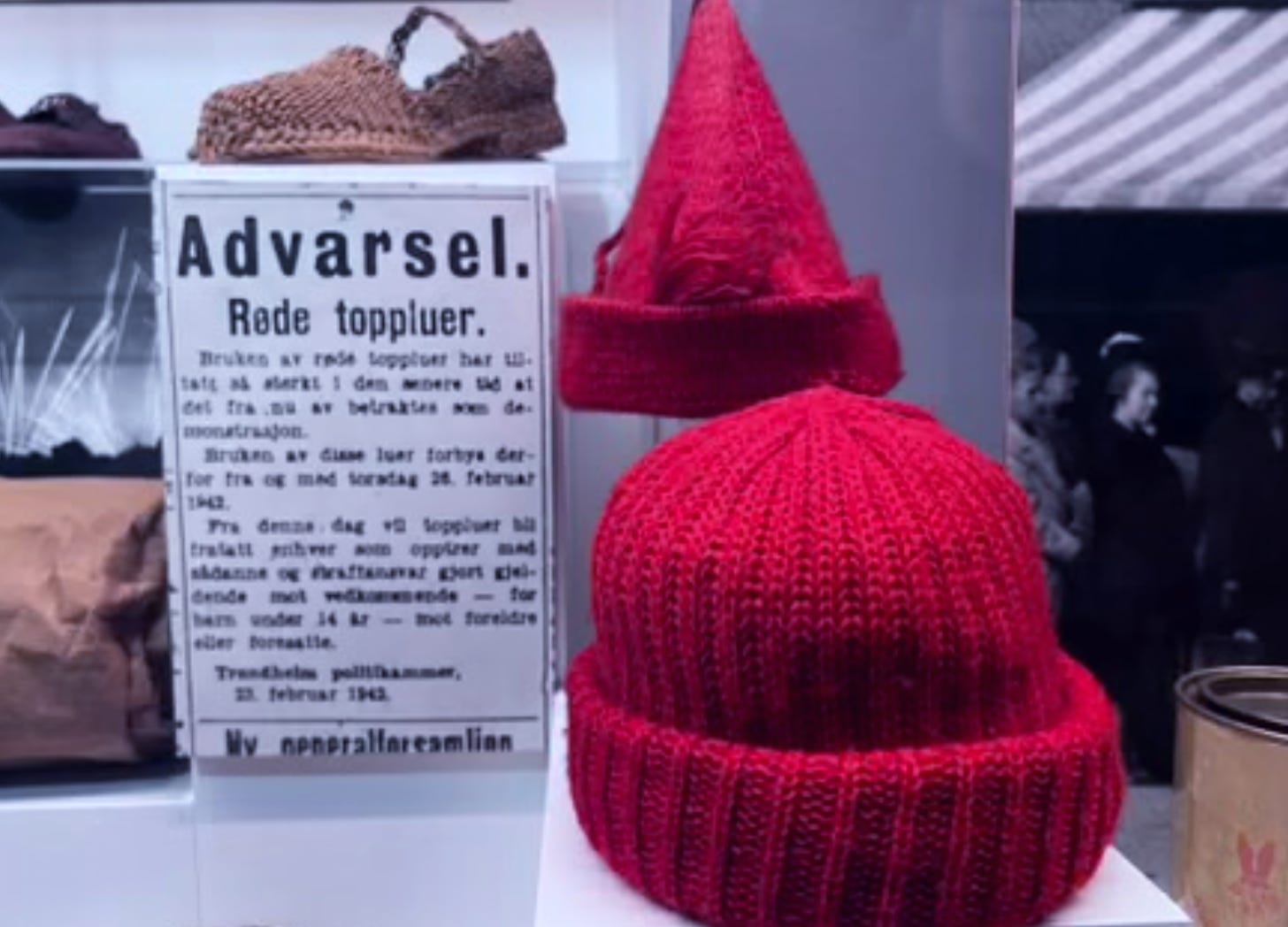
Authoritarians try to own symbols because symbols move people faster than policy memos ever could. Symbols tell us who belongs, who stands together, and who refuses to disappear.
That’s why they police colors.
That’s why they obsess over clothing.
That’s why they panic when resistance becomes visible.
Right now, something small but unmistakable is happening in public space.
Red hats are showing up again.
Not the mass-produced red cap that became shorthand for grievance and cruelty. Something older. Handmade. Pointed. Tasselled. Worn on purpose.
We’ve seen this before.
When Visible Unity Became Illegal
During World War II, Norwegians living under Nazi occupation found ways to resist without weapons. One of those ways was simple and public: they wore red knitted hats.
Everyone understood the message. We are still here. We do not consent.
The Nazis understood it too. The hats became so effective as a signal of unity that the occupation government moved to criminalize them, eventually banning red wool caps as symbols of national unity.
That fact matters.
You don’t outlaw yarn unless visible solidarity threatens your control.
The hats worked because they broke isolation. They let people recognize each other on the street without speaking. They told strangers, you’re not alone.
Why Red Is Showing Up Again Now
Fast forward to the present.
After ICE escalated enforcement in Minnesota, terrorizing immigrant communities and killing community members, people did what resistance movements always do. We organized. We watched out for each other. We refused silence.
And we reached for a symbol that carries history.
A local designer created the “Melt the ICE” hat, directly inspired by the Norwegian resistance hats. People began knitting and crocheting them. Not as fashion. As presence. As memory. As refusal.
This works because we use it together. If you want to move this from visibility to impact, here’s how we organize around it.
You can knit or crochet the hat using patterns created specifically to keep participation accessible. The original “Melt the ICE” design sends proceeds directly to immigrant aid through the Melt the ICE knitting pattern, and a matching option exists for crocheters through the Melt the ICE crochet pattern. Even buying a pattern without making a hat functions as a donation.
If cost or skill is a barrier, a free crochet version is available through this red tassel hat pattern, and people who want to learn step-by-step can follow along with a long-form Melt the ICE hat tutorial on YouTube.
If you can’t craft, you can still support the work directly by donating to immigrant defense efforts coordinated by organizers at Eyes on ICE.
Wear the hat in ordinary places. Share the story when you post. Visibility breaks isolation. Recognition builds power.
What matters just as much as the money is the visibility.
These hats are appearing at protests, vigils, grocery stores, bus stops. They say what many people feel but struggle to voice: we see what’s happening, and we are not backing down.
This Isn’t Nostalgia. It’s Strategy.
Authoritarians depend on isolation. They want people to feel unsure, invisible, alone. Symbols interrupt that. Symbols recruit. Symbols tell the person next to you, you’re not imagining this.
That’s why reclaiming red matters.
This isn’t about crafting. It’s about refusing to let extremists monopolize public space or visual language. It’s about reminding each other that resistance doesn’t always look like a march. Sometimes it looks like a hat worn where others can see it.
If you can’t craft, you can still support the work directly by donating to immigrant defense efforts coordinated through organizers at Eyes on ICE.
How We Show Up
We don’t need permission to be visible.
We don’t need to wait until it’s dangerous to act.
We just need to recognize each other.
And right now, red is doing that work.
Share this. Symbols become protection when we move them together.
Tell us how you’re taking part or where you’re seeing red knit hats show up.
Authoritarians try to own symbols because symbols move people faster than policy memos ever could. Symbols tell us who belongs, who stands together, and who refuses to disappear.
That’s why they police colors.
That’s why they obsess over clothing.
That’s why they panic when resistance becomes visible.
Right now, something small but unmistakable is happening in public space.
Red hats are showing up again.
Not the mass-produced red cap that became shorthand for grievance and cruelty. Something older. Handmade. Pointed. Tasselled. Worn on purpose.
We’ve seen this before.
When Visible Unity Became Illegal
During World War II, Norwegians living under Nazi occupation found ways to resist without weapons. One of those ways was simple and public: they wore red knitted hats.
Everyone understood the message. We are still here. We do not consent.
The Nazis understood it too. The hats became so effective as a signal of unity that the occupation government moved to criminalize them, eventually banning red wool caps as symbols of national unity.
That fact matters.
You don’t outlaw yarn unless visible solidarity threatens your control.
The hats worked because they broke isolation. They let people recognize each other on the street without speaking. They told strangers, you’re not alone.
Why Red Is Showing Up Again Now
Fast forward to the present.
After ICE escalated enforcement in Minnesota, terrorizing immigrant communities and killing community members, people did what resistance movements always do. We organized. We watched out for each other. We refused silence.
And we reached for a symbol that carries history.
A local designer created the “Melt the ICE” hat, directly inspired by the Norwegian resistance hats. People began knitting and crocheting them. Not as fashion. As presence. As memory. As refusal.
This works because we use it together. If you want to move this from visibility to impact, here’s how we organize around it.
You can knit or crochet the hat using patterns created specifically to keep participation accessible. The original “Melt the ICE” design sends proceeds directly to immigrant aid through the Melt the ICE knitting pattern, and a matching option exists for crocheters through the Melt the ICE crochet pattern. Even buying a pattern without making a hat functions as a donation.
If cost or skill is a barrier, a free crochet version is available through this red tassel hat pattern, and people who want to learn step-by-step can follow along with a long-form Melt the ICE hat tutorial on YouTube.
If you can’t craft, you can still support the work directly by donating to immigrant defense efforts coordinated by organizers at Eyes on ICE.
Wear the hat in ordinary places. Share the story when you post. Visibility breaks isolation. Recognition builds power.
What matters just as much as the money is the visibility.
These hats are appearing at protests, vigils, grocery stores, bus stops. They say what many people feel but struggle to voice: we see what’s happening, and we are not backing down.
This Isn’t Nostalgia. It’s Strategy.
Authoritarians depend on isolation. They want people to feel unsure, invisible, alone. Symbols interrupt that. Symbols recruit. Symbols tell the person next to you, you’re not imagining this.
That’s why reclaiming red matters.
This isn’t about crafting. It’s about refusing to let extremists monopolize public space or visual language. It’s about reminding each other that resistance doesn’t always look like a march. Sometimes it looks like a hat worn where others can see it.
If you can’t craft, you can still support the work directly by donating to immigrant defense efforts coordinated through organizers at Eyes on ICE.
How We Show Up
We don’t need permission to be visible.
We don’t need to wait until it’s dangerous to act.
We just need to recognize each other.
And right now, red is doing that work.
i just wonder about all the obsession with symbols. The pink pussy hat (which I really disliked for a bunch of reasons) comes to mind, and more recently the purple bandanas, and now the red hats. What if we just focus on resisting with meaningful signs, drums, whistles, and frogs? I understand the symbolism of the red hats, but they require a good amount of explaining, and besides red makes me think of t-Rump's big red tie. No amount of explaining gets rid of that in my mind's eye. Just an opinion. I'm sure many will disagree.
Great article Jennifer. One suggestion would be to make the links more obvious or use custom buttons. I noticed that the links in my substack articles are a brighter blue and stand out more.
After doing some research I discovered that you might be able to make your links more visible by doing the following:
1.) Get into your Substack Dashboard
2.) Click on Settings (Bottom of sidebar menu)
3.) Click on Website (Under Appearance section of sidebar menu)
4.) Click on the Go to website theme editor (Big button near top of screen)
5.) Click on Branding (Top of sidebar menu)
6.) Change Accent Color to a brighter color. Mine is: 0068EF
Pretty well hidden like a few other important settings.
While you are at it, you might want to change the Web Background Color to a color that looks like parchment paper. This is popular because it's easier on the eyes and links stand out. I have mine set at: FFF2D1
Feel free to check out some of my Substack articles for examples.
Feel free to reach out to me if you have any questions. Be sure to identify yourself as Jennifer from Demcast so that I don't ignore you. I'm a fellow Demcast volunteer.